
Interview
Drones, AI and Autonomous Swarms: Serge Chaumette’s Analysis
Professor at the University of Bordeaux and researcher at LaBRI (Bordeaux Computer Science Research Laboratory, CNRS UMR 5800), Scientific Director of IcarusSwarms.ai, a company dedicated to counter-drone system evaluation and military applications.
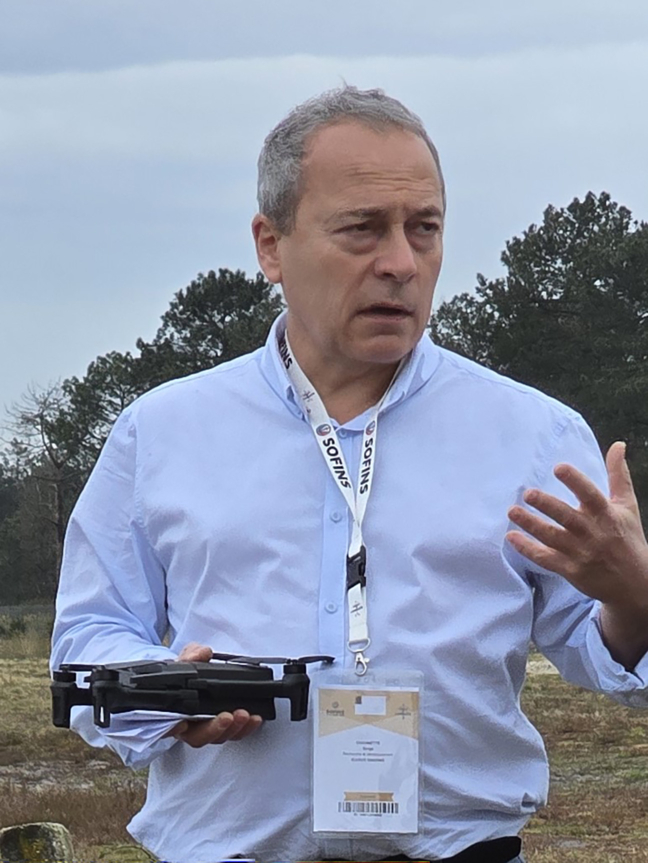
Could you introduce yourself and explain your field of research around drones and autonomous systems?
I am a Professor at the University of Bordeaux and a researcher at LaBRI (Bordeaux Computer Science Research Laboratory, CNRS UMR 5800). Holding a PhD in computer science, I have both a research-oriented profile and a more business, product, and industrial implementation background, thanks to my engineering degree in networks and systems. I oversee drone-related activities at LaBRI and co-lead the Teleoperated Systems group within GIS Albatros, a scientific alliance between the University of Bordeaux and Thales. I am also a member of the Strategic Committee for Drones and New Uses at Aerospace Valley, the global competitiveness cluster.
Throughout my career, I have led several research projects conducted with companies such as Naval Group, Thales, Gemalto, and NXP, as well as with governmental organizations such as the DGA/AID, sometimes within European frameworks under the EDA. I have also collaborated with American institutions such as the ONR (Office of Naval Research) and the ARL (Army Research Laboratory). Today, within the France 2030 framework, I lead the Pandrone project, which brings together 17 partners with the goal of ensuring airport perimeter surveillance.
My research focuses on secure fleets and swarms of autonomous systems (drones, ground robots, etc.), in which degraded operating modes are considered the standard use case. In other words, I work on systems where no assumptions can be made regarding the availability of communication links or the devices composing the swarm(s). My work combines both theoretical aspects and the design and deployment of applications in real-world environments. In particular, together with members of my team and in collaboration with Thales for the experimental part, we designed and deployed in 2012 the first fully autonomous and self-organized drone swarm.
I am also co-founder and Innovation Director of the startup Preditic, which specializes in predictive industrial maintenance using sensors, short-range communication technologies, and, where relevant, artificial intelligence.
Finally, I am the Scientific Director of IcarusSwarms.ai, a company dedicated to evaluating counter-drone systems and military swarm applications, with solutions already deployed within armed forces.
In today’s rapidly evolving technological landscape, what role do drones play in civil, defense, and scientific fields?
The use of drones is becoming widespread; the phenomenon is undeniable and almost commonplace today. From search and rescue operations to crop pollination and the monitoring of industrial or sensitive infrastructures, drones have become part of everyday life.
In the civil sector, use cases are expanding, whether simple or highly complex. These are often niche applications that can struggle to find their market. As a result, “off-the-shelf” reusable products tend to stand out. Examples include surveillance of sensitive sites, support for police forces, and applications in agriculture. More broadly, these are applications capable of scaling commercially. This does not prevent the development of larger projects. Take the Pandrone project, for example, led by the New Aquitaine ecosystem and coordinated by the French National Research Agency (ANR-23-DMRO-0009) under the “Robotics Transfer Challenges” program within France 2030. Critical infrastructure security is a prime target in a world where asymmetric warfare is a major issue. Airports are particularly attractive targets for terrorist attacks, but they are also critical hubs for a country’s economy. Even a non-malicious intrusion can shut down airport operations, causing significant economic consequences. Pandrone aims to ensure perimeter surveillance of port infrastructures by combining sensors, drones, robots, and artificial intelligence. Bringing together 17 partners, it represents a concentration of some of the most innovative technologies available today. There is therefore room for large-scale projects, although they require substantial groundwork before convincing stakeholders and reaching a real market.
In the military sector, the war in Ukraine is widely recognized as an accelerator for drone and robotic technologies, especially drone swarms. The rapid — even lightning-fast — response capability of Ukrainian forces, both in the air and at sea, is now acknowledged by observers worldwide (fiber optics, carrier drones, FPV drones, etc.). We are rediscovering — or rather realizing after years of neglect — that small and medium-sized drones represent a genuine force multiplier. Even basic or homemade drones can become formidable weapons. Their low cost and ability to be mass-produced quickly make them particularly effective tools. Iranian Shahed drones are a striking example. Adaptability, responsiveness, low cost, and production volume are now becoming more decisive factors than sheer complexity.
Scientific research remains essential. The trio of industrial players, end users, and researchers is fundamental. End users are the only ones able to define the functional requirements of future solutions. Industrial companies possess the teams and expertise needed to implement these functions. Researchers, meanwhile, imagine, prototype, and transfer solutions that may not appear in industrial roadmaps because they can seem too futuristic or not immediately profitable. Many building blocks of these systems stem from academic research or require more fundamental studies. Laboratories today are closely connected to the socio-economic world and are strongly encouraged to maintain these links.
In your opinion, what are the major challenges facing drone development, particularly regarding artificial intelligence, security, and regulation?
Artificial intelligence, security, and regulation are major cross-cutting challenges. No technological advancement or new use case can now be integrated into a product without considering them.
First, artificial intelligence. It opens up an extremely broad spectrum of possibilities, but also many questions. The autonomous decision-making capability it provides paves the way for applications that were previously difficult to imagine. Issues related to explainability, certification, learning, and onboard integration remain largely unresolved. Drones — as well as robots and sensors — are remote extensions of human action. But to achieve a true form of remote human presence, intelligence must be embedded within them. This is where AI comes into play — controlled AI, because the operational environments are often sensitive (cities, airports, etc.).
AI also impacts the second major issue: security. Security must be addressed through three paradigms: the safety of assets (people and equipment), the security of devices themselves, and cybersecurity, which can almost be considered a paradigm in its own right.
Finally, these issues both influence and are influenced by regulation and airspace management challenges. However, these constraints must not become barriers to technological development or to real-world operational deployment. Competitors — particularly in Asia, though not exclusively — are often more flexible on these issues, especially during experimentation phases, allowing them to bring operational products to market more quickly.
Looking ahead 10 years, how do you envision the evolution of drones and their integration into everyday life and major systems such as cities, security, and the environment?
The current revolutions represented by AI and quantum technologies will profoundly impact the field.
AI, of course, will become less energy-intensive, more explainable, and even more powerful. It is difficult to predict exactly what will emerge, but system autonomy will fully come into its own, with dynamic mission adaptation. Explainability, by making AI decisions understandable, will help remove certain regulatory barriers and expand the range of possible operations.
Quantum technologies will dramatically increase computing power, even during flight. However, they will also bring new security challenges, rendering some current protections obsolete, although so-called post-quantum encryption algorithms will emerge in response.
In any case, these technologies will be everywhere, from the smallest to the largest systems: the personal companion drone, much like today’s smartphone, acting as an extension of the human being (a component of the transhumanist vision pursued by some); service drones for delivery or transport; or security drones capable of remaining airborne indefinitely, monitoring sensitive areas continuously in high resolution (a concept imagined several years ago in the United States), enabling historical reconstruction after incidents — a kind of virtual journey back in time.
Finally, all these systems will collaborate with one another. The ecosystem itself will form a massive swarm: a cloud of aerial, ground, surface, and underwater drones powered by AI. Together, they will constitute a global cyber-physical cognitive swarm.