
Defence Drones in Europe: Bordeaux at the Heart of the Strategic Shift
Since 2024, Europe has significantly accelerated the development of its military drone capabilities in response to the war in Ukraine and the United States' strategic repositioning. Through ReArm Europe (worth up to €800 billion), the AGILE programme and the Drone Action Plan launched in February 2026, Europe aims to achieve defence industrial autonomy by 2030.
| Article by Anaïs LADAS Drone Industry Project Manager – Bordeaux Technowest |
Why did Europe shift into defence catch-up mode in 2025–2026?
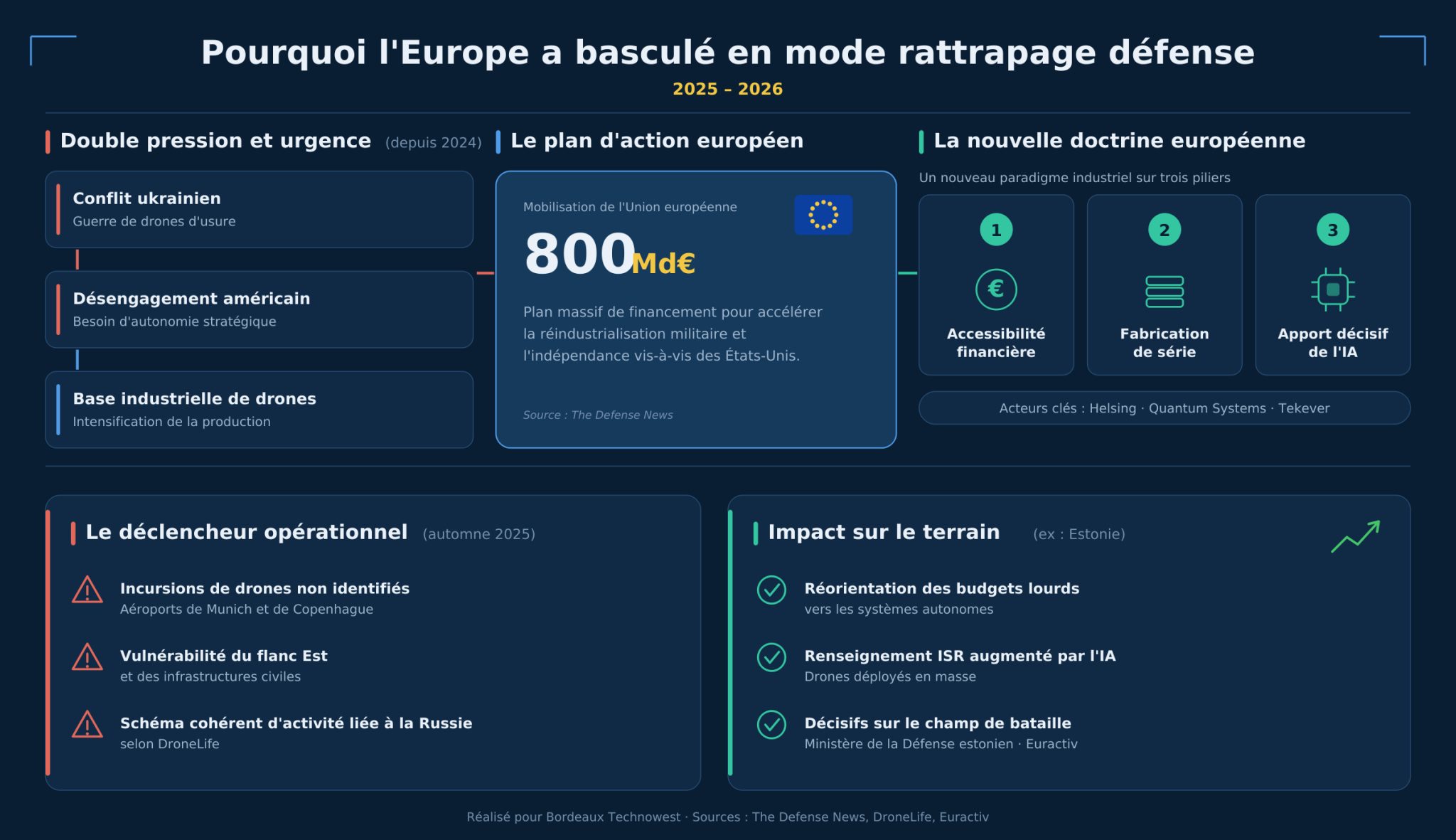
Since 2024, Europe has urgently strengthened its domestic drone industrial base under the combined pressure of the war in Ukraine and the gradual reduction of US military engagement. To accelerate the reindustrialisation of its defence sector and reduce dependence on American suppliers, the European Union has launched an ambitious €800 billion investment plan (The Defense News).
The operational wake-up call is now undeniable. The incursions of unidentified drones over Munich and Copenhagen airports in autumn 2025 exposed the vulnerability of Europe's eastern flank and its critical civilian infrastructure. According to European authorities, these incidents reveal a consistent pattern of activity linked to Russia (DroneLife).
Europe's new defence doctrine is reflected in the rapid rise of companies such as Helsing, Quantum Systems and Tekever. Together, they embody a new industrial model built on three pillars: affordability, mass production and the decisive contribution of artificial intelligence. The European doctrine has clearly evolved. According to Estonia's Ministry of Defence, AI-enhanced ISR capabilities and the large-scale deployment of drones have become decisive on the battlefield, prompting the country to redirect significant defence spending towards autonomous systems (Euractiv).
ReArm Europe, AGILE and SAFE: How the EU is Boosting its Defence Industry
The European Commission has committed up to €800 billion to defence through the ReArm Europe / Readiness 2030 plan, including the €150 billion SAFE loan instrument dedicated to joint procurement between Member States (European Parliament, 2025).
SAFE represents a major shift away from traditional transatlantic procurement practices. By excluding US suppliers, it aligns with European Commission regulations requiring at least 65% of the value and components of funded defence equipment to originate within Europe. This marks a clear break from two decades of reliance on American defence procurement.
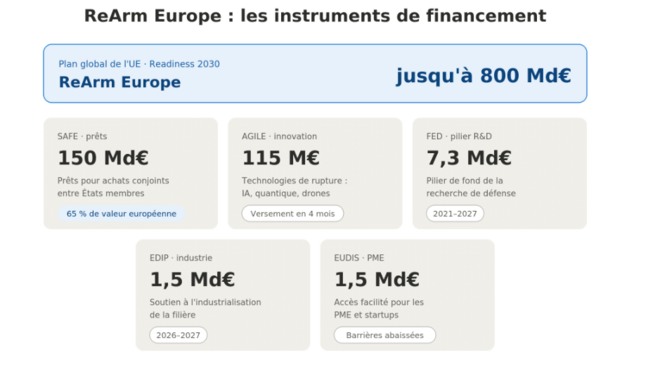
Launched in March 2026, the AGILE programme allocates €115 million to disruptive technologies including artificial intelligence, quantum technologies and drones. Its most innovative objective is to reduce the time between grant application and funding to just four months (Euronews, April 2026). In an industry evolving at exceptional speed, rapid access to funding has become just as critical as the funding itself.
Meanwhile, the European Defence Fund (EDF) remains the backbone of long-term investment, providing €7.3 billion for the 2021–2027 period. It is complemented by EDIP (€1.5 billion for 2026–2027), focused on industrialisation, and EUDIS (€1.5 billion), which lowers barriers to entry for SMEs and start-ups (Euronews).
The European Drone Defence Initiative and the Eastern Drone Wall
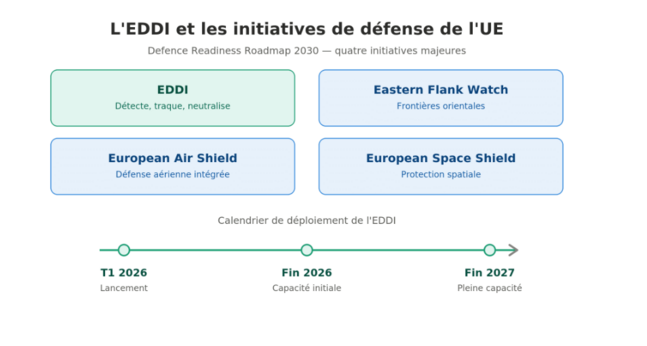
The European Drone Defence Initiative (EDDI) is the flagship project of Europe's new defence architecture. Presented on 15 October 2025 as part of the Defence Readiness Roadmap 2030, the initiative replaces the former "Drone Wall" concept with an interoperable, multi-layered system designed to detect, track and neutralise hostile drones (European Parliament – EPRS, October 2025).
Its implementation follows three official milestones: launch in the first quarter of 2026, initial operational capability by the end of 2026, and full operational capability by the end of 2027. EDDI stands alongside Eastern Flank Watch, the European Air Shield and the European Space Shield as one of Europe's four major strategic defence initiatives.
On 11 February 2026, the European Commission published its Action Plan on the Security of Drones and Counter-Drone Systems, translating this ambition into concrete measures. The plan encourages Member States to transform their 5G networks into distributed radar systems by leveraging the continent's 350,000 base stations (GIS Reports, April 2026; European Commission, February 2026).
On the industrial front, €6 billion generated from frozen Russian assets has been allocated to drone production. This funding is accompanied by the launch of the EU-Ukraine Drone Alliance, designed to transfer battlefield experience directly to European defence manufacturers (EPRS).
Why is Bordeaux Playing a Strategic Role in October 2026?
What if part of Europe's next major industrial transformation were taking place in south-west France?
Within this rapidly evolving landscape, UAV SHOW 2026 occupies a unique position. This edition marks a significant expansion of the defence dimension. Rather than simply highlighting civil-military synergies, the event now fully embraces defence through three dedicated sectors: Defence, Civil and Dual-Use.
-
110
exhibitors expected
-
4,000
industry professionals
-
3 dedicated sectors
Defence | Civil | Dual-Use
Through its 110 exhibitors, the exhibition showcases every segment of the drone value chain, including GPS-denied navigation, embedded AI and counter-drone technologies, while bringing together armed forces, international delegations (EU and NATO), manufacturers and innovative start-ups.
Why such strong momentum around dual-use technologies? Because drones have become essential across both civilian and military applications. Examples are multiplying: Tekever develops maritime surveillance drones used by both Frontex and the Portuguese Armed Forces; Quantum Systems supplies ISR platforms for agriculture, geospatial surveying and defence customers alike; and laser-based counter-drone systems originally developed for military use are now protecting critical civilian infrastructure.
For the Bordeaux drone ecosystem, the challenge is twofold: securing a share of the €800 billion ReArm Europe investment while positioning itself at the centre of Europe's emerging defence industrial ecosystem.
The first opportunity is funding. Programmes such as the EDF, EDIP, EUDIS and AGILE now explicitly support SMEs and start-ups. A recent example is Aerix Systems, incubated by Bordeaux Technowest, which has joined NATO's DIANA programme dedicated to strategic defence technologies—an important milestone for the French company specialising in autonomous systems and counter-drone solutions.
The second opportunity is testing and validation. As the Eastern Drone Wall, EDDI and Europe's 5G radar network reshape the sector, Bordeaux Technowest is organising and strengthening its regional ecosystem. Its key asset is CESA Drones, one of the very few European test sites authorised to conduct real-world drone demonstrations—exactly the type of facility the European Commission is seeking to accelerate the transition from prototype to operational deployment.
UAV SHOW 2026 therefore positions Bordeaux as a strategic hub in Europe's defence industrial acceleration. With a strong presence of armed forces, French and European institutions, international delegations and a dedicated live flight demonstration day on 9 October in Sainte-Hélène, the event establishes the region as a key player in shaping the future of European defence.