
Civilian Drones in the Shadow of Military Drones
Interview with François Baffou, CEO of Bordeaux Technowest, conducted by Gil Roy, professional journalist, aviation and general aviation expert, and founder of Aerobuzz. As every year, he promises an in-depth analysis and engaging discussions on the challenges facing the drone industry as moderator of the UAV Show round tables.
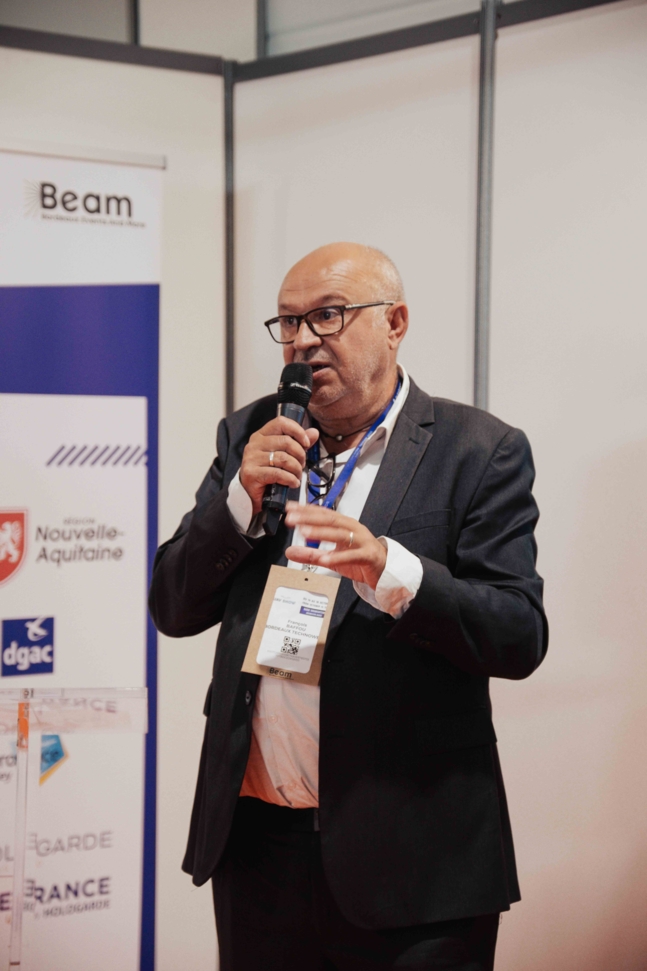
Although it has moved into the background, the civilian drone sector remains dynamic. It is benefiting from the experience gained on the Ukrainian battlefield since 2022. This is what UAV Show 2026 (Bordeaux, 7–9 October 2026) is expected to demonstrate, with the exhibition space having doubled compared with the previous edition.
The war in Ukraine has revealed the potential of drones. After four years of war, military applications appear to be virtually limitless. In the media, they completely overshadow civilian applications. In 2022, when the war in Ukraine began, France had already had regulations governing the use of civilian drones for ten years. Yet we were still largely at the stage of controlled experimentation, rather than actual commercial deployment, with the exception of certain specific sectors.
Over the past four years, the drone sector has been in turmoil. In France in particular, most of the start-ups established in the early 2010s, which had become SMEs by the early 2020s, have shifted towards the military market. Toulouse-based Delair is a good example: its turnover rose from $10 million in 2023 to €50 million in 2025. The company secured major contracts covering hundreds of intelligence-gathering drones, such as the DT26 and DT46, as well as France’s first remotely operated munitions, the Colibri and Oscar kamikaze drones. Like Delair, which now generates 20% of its business from the civilian sector, many companies have nevertheless maintained a foothold in civilian applications.
‘Civilian activity is still there. In audiovisual production, imaging, agriculture, surveillance, security and safety. Civilian applications have moved into the media background, but the activity itself has not declined. There is still demand,’ says François Baffou, CEO of Bordeaux Technowest and founder of UAV Show in 2010. The civilian sector is benefiting from lessons learned on the Ukrainian battlefield.”
UAV Show, originally a French event and now a European meeting point for the drone industry, has never been content simply to showcase the market’s offering. Since its creation, it has established itself as a key industry player, supporting project leaders and start-ups throughout the year.
Through UAV Show, Bordeaux Technowest has played an active role in the development of regulations designed to encourage the emergence of a supply ecosystem in a promising market. In practice, the 2012 French regulations primarily provided a framework for the activity. However, they also served as the basis for European regulations, which have been in force since 2025.
“European regulation was a useful and necessary development,” acknowledges François Baffou. “It is worth noting that it is the only regulatory framework in the world covering nearly 30 countries. It is certainly not perfect, as applications may sometimes vary from one country to another, but at least it exists, even though work is already under way to evolve it.”
It is against this broader backdrop that Pilgrim Technology, which originally developed a civilian cargo transport drone in 2012, now offers the armed forces the Dragon P30, a drone capable of carrying a 30 kg payload and supplying troops on the front line.
The most spectacular development, however, remains that of Tekever. Within just a few months, the company has evolved from an idea pursued for several years by a Portuguese engineer into a pan-European industrial company with operations in Ukraine, Portugal, the United Kingdom and France.
Now describing itself as “a leading pan-European technology company”, it employs nearly 1,500 highly qualified staff. Tekever will have a strong presence at UAV Show 2026, alongside other major players in military drones and defence, including Thales, Safran, Dassault Systèmes, Roxel and KNDS.
The exhibition space has doubled compared with the previous edition, and the military offering is expected to be particularly prominent.
Last year, at the 2025 edition, civilian exhibitors still accounted for 55% of the total. In 2026, François Baffou expects 60% of companies to be focused on defence, 15% on civilian applications, representing around twenty companies, and 25% to operate across both markets.
“We are seeing a breakthrough in dual-use applications,” says the CEO of Bordeaux Technowest.
To support this underlying trend, he intends to continue giving civilian solutions a place at the exhibition.
“The powerful technological developments taking place in the military sector represent just as many opportunities for civilian applications. In the short term, many countries, starting with France, need to equip themselves, particularly when it comes to counter-drone systems, but they must also consider the large-scale production of drones.”
There is no doubt that, once again, war is proving to be a catalyst — an open-air laboratory for innovation.
Driven by artificial intelligence, which is significantly increasing the operational reliability of military drones, civilian drones will in turn become more reliable, safer and more secure.
Regulation will have to keep pace.